
The Phantom Scythe: How AI is Quietly Locking the Door on the Next Generation
AI is not taking jobs from current workers. It is taking them from the young
Borja C.
3/6/20262 min read
We expected a bloodbath.
When the generative AI wave broke, the prophets of Silicon Valley promised a sudden, violent severing of human labor from the economic machine. We braced for mass layoffs, breadlines for coders, and the sudden obsolescence of the laptop class.
But look at the data. The apocalypse is remarkably quiet.
According to a new autopsy of the labor market by Anthropic, the immediate unemployment spike hasn't materialized. Since the release of ChatGPT in late 2022, there has been no systematic rise in joblessness for the most AI-exposed workers. The scythe hasn't swung.
But to look only at the unemployment line is to miss the war entirely. Anthropic’s research, which cross-references the theoretical capabilities of Large Language Models with actual, real-world usage data, reveals a structural shift. AI isn't firing the modern workforce.
It is starving the pipeline.
The White-Collar Paradox Historically, the specter of automation was a blue-collar ghost, haunting factory floors and assembly lines. AI flips the script entirely. Anthropic’s "observed exposure" metric reveals that the workers staring down the barrel of automation are overwhelmingly older, female, highly educated, and highly paid. They are the financial analysts, the customer service reps, and above all, the computer programmers.
The physical world remains fiercely human. The cooks, the mechanics, the lifeguards... they are completely untouched. The digital realm is where the perimeter is shrinking. But because this exposed class is affluent and politically entrenched, they aren't being summarily fired. They are being augmented. They are doing more with less. Which leads to the most chilling revelation in the data.
The Ghosting of the Junior Class The most profound second-order implication of Anthropic’s study is hidden in the youth hiring metrics. Unemployment is flat, yes. But new job starts for young workers, the 22 to 25 year old lifeblood of the labor market, have dropped by 14% in highly exposed occupations.
The door is locking from the inside.
Firms aren't issuing pink slips to their senior developers or veteran analysts. Instead, they are realizing that a single senior architect armed with Claude or Copilot can do the work of a senior and three juniors. The entry-level job, the ancient, necessary crucible where apprentices learn the forge of their industry, is quietly evaporating.
The Demographic Time Bomb This is the invisible crisis. If the labor market ceases to hire the young to perform the mundane, repetitive coding and administrative tasks that AI now devours, how do we build the next generation of masters? The junior tiers of the modern economy have always been a training ground. You learn to build the skyscraper by carrying the bricks.
If the machine carries the bricks, the 24-year-old never learns the architecture.
We are facing a catastrophic hollowing-out of human capital. In ten years, when the current crop of senior, highly-paid talent retires, who steps up? We are risking a "missing generation" of workers who were denied the foundational repetitions necessary to achieve mastery.
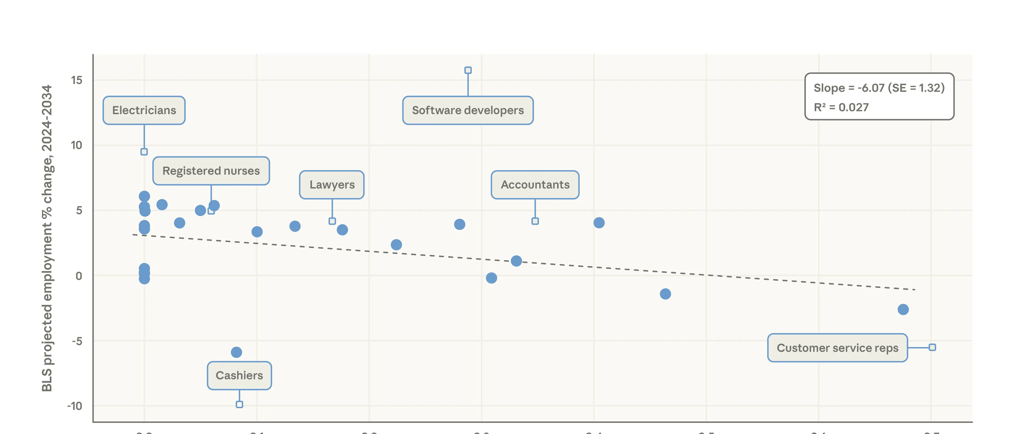
Anthropic’s data proves that AI is still far from reaching its theoretical limits. Actual coverage is still just a fraction of what is computationally feasible. But the US Bureau of Labor Statistics is already projecting stunted growth for these highly exposed roles.
We aren't witnessing a Great Depression of sudden unemployment. We are witnessing a slow-motion freeze. The machine isn't firing you today. It's just ensuring that tomorrow, you have no replacement. The future isn't jobless, it's just pulling up the ladder.
Contact
Reach out for AI solutions today
Subscribe
info@computelabtech.com
Corporate Email
© 2026. All rights reserved.